
.png)


OUR PHILOSOPHY
Statement on Breeding Ethics
Breeding horses is a controversial topic, and for good reason. It’s an essential conversation when discussing sustainability and ethics in the equine industry.
At SKE, our entire mission revolves around ethical, sustainable equestrianism—and when it comes to breeding, that means:
1. Condemning Commercial Breeding: Breeding foals with the intention of rehoming them is unacceptable and unethical, given the severity of the equine overpopulation crisis.
2. Supporting Ethical, Sustainable Rescue & Rehoming: Rescues are overrun and overwhelmed. Support rescues by adopting, fostering, volunteering, and donating. Consider direct rehoming only when it's in the best interest of the horse.
3. Holding Personal Breeders to the PRIME Standard: Breeding should be reserved for equine caretakers with the knowledge and experience needed to make informed decisions regarding breeding, and the resources to back up those decisions. Breeding should adhere to the PRIME standard, and breeders must assume lifelong responsibility for their foal, and be prepared to assume responsibility for the mare and/or stallion, if needed.
You may have seen some adorable pictures of foals at SKE, so we want to make something clear:
SKE has NEVER participated in commercial/for profit breeding.
And we never will.
SKE has used our unique ability to provide expert equine reproductive care to further our mission of bringing the theory behind ethical, sustainable horsemanship into reality. Steph is certified in equine reproduction and her background in traditional horsemanship included work at breeding barns and work as a vet tech—she's seen it all, from multimillion-dollar "designer foals" to backyard-breeding nightmares. She's also confronted the reality of the equine overpopulation problem firsthand and struggled with the weight of that industry-wide problem.
Steph chose to use her knowledge and experience for good, in two key ways:
1. Assisting with rescue mares and raising rescue foals. SKE has proudly assisted with a number of rescue mares who otherwise wouldn't have had access to the specialized support and care that we are able to provide. We've also raised a number of rescue foals, helping them grow into healthy, well-adjusted adults and giving them the start they need to live happy, full lives once adopted.
2. Elevating the industry standard, by demonstrating ethical, sustainable breeding. This includes Steph's personal foals (Spud & Pickles), as well as assisting clients who are committed to ethical, sustainable breeding, and have the knowledge and resources needed to do things right.
Read more below about what's involved in sustainable, ethical breeding...


Sustainable Breeding - is it possible?


Sustainability needs to be at the heart of any discussion involving horse breeding. If we don't address the equine overpopulation crisis, we can't consider how our actions could contribute: Are we part of the problem? Or part of the solution?
The reality is: the equine industry is not sustainable. There are far more horses being born every day than there are quality, lifelong homes available. So, when we talk about breeding, we have to ask: Why create more horses, when so many are already in need?
But when we examine this problem closely, it becomes clear that breeding isn't the root of this issue—it's a symptom of a bigger problem: an industry that treats horses as disposable commodities. Breeders keep breeding because buyers keep buying, and buyers keep buying because horse trading is so normalized. Professionals estimate that horses have an average of 7-10 homes throughout their lifetime, and the vast majority of horse owners will not keep their horse through retirement.
Too often, horses are treated like sporting equipment or financial investments—used until they can no longer perform, and then discarded. No horse is rideable for their entire life. Every single horse will go through phases where they can't be ridden, (ie, when too young or old, when they have physical issues like injury, illness, saddle fit, etc.). Yet, so many people only value a horse if they can be ridden. This creates a harmful, transactional relationship, where a horse’s worth is tied to what they can do, rather than who they are. Regardless of the quality of breeding or initial sale value, no horse is safe from being "sold down the road" if they can't meet the performance expectations of their current owner.
We can do our best to address breeding as a part of the overpopulation crisis, but at the end of the day, that's a "band-aid" solution. Breeders will keep producing an unsustainable number of horses as long as the industry continues to absorb them—and it's easy to deflect blame to the slaughter traders, the racetrack, the backyard breeders, or any problematic group that can be singled out. But it's not one groups fault, it's an industry-wide problem. Every person who buys or sells a horse is contributing to that problem, even if they don't mean to, even if they provide a great home in the meantime, and even if they love that horse. Until we stop normalizing the culture of sales and trading, and until we embrace a culture of lifelong commitment, we will continue to fuel the breeding industry.
So we know the norm isn't sustainable, but is sustainable breeding possible? Yes.
Sustainable breeding starts with ethical breeding, which adheres to the PRIME breeding standard. It continues when equestrians stop supporting commercial breeding and sales, and instead focus on ethical rehoming, like adopting from a rescue. It takes root when those who profit off of horses—the high-performance competitors, ranch workers, lesson schools, etc.—take lifelong responsibility for every horse they buy and use. Read more about what it means to make a Lifelong Commitment to a horse.
Keep reading to learn more about sustainable, ethical breeding.
Ethical Breeding - is it possible?


Ethical considerations need to be at the heart of any discussion involving horses. This means considering how our actions will influence the welfare of our horses.
To breed responsibly, we must be prepared to commit to the foal for their entire life—not just the cute baby stage, not just the riding or performance years, but for all of it. Who will care for this horse for the next 20-30 years? Where will they live? How much will it cost? Read more about what it means to make a Lifelong Commitment to a horse.
Breeding responsibly also means breeding without strings attached. The horse will still need to eat, even if he can't ever be ridden, ends up the wrong color, or doesn't want to perform in the sport you had hoped to enjoy together. Ethical breeders commit to lifelong care, regardless of how the foal turns out.
When breeding, the ethical considerations extend not only to the foal, but to the mare and stallion as well.
If they ever need a safety net, could we provide it? If the answer is no, then we shouldn't be breeding—why create a new life when we can't even guarantee the safety of the existing ones?
Beyond that, breeders need to ask:
Is it in the stallion’s best interest to remain intact? Can he live a happy, enriched life without excessive restraint, force, or isolation? If not, he should be gelded—no matter how impressive his bloodlines are.
Is it in the mare’s best interest to carry and nurse a foal? Is she physically and emotionally prepared for it? Will weaning be handled in a species-appropriate, trauma-informed way?
Are there appropriate facilities, professionals, and handling protocols, to ensure ethical breeding practices? Whether it’s natural cover, live cover, artificial insemination, or embryo transfer—breeding should never be traumatic or forceful for anyone involved.
Breeding is a CHOICE—one that creates new life, new responsibilities, and new risks. A variety of veterinary interventions will be required to set everyone up for a safe, healthy pregnancy and birth—those expenses are optional, in that you can choose to avoid them by choosing not to breed! No mare or foal should suffer because a breeder chose to risk their health when they didn't have the funds for reproductive care.
When we breed, we are intentionally creating additional risk for the horses involved. Reproductive complications aren't the same as unexpected illness or injury. If we can't afford the cost of complications, then we can't afford to be breeding.
Lastly, all of this additional care and all of these specialized procedures need to be done ethically, meaning the horses should be prepared in advanced so we can use cooperative care, instead of relying on restraint or force. If the horses involved aren't prepared to cooperate with a vet as needed, we shouldn’t be breeding them.
So is ethical breeding possible? Absolutely. We can ensure mare, stallion, and foal have lifelong support and that everyone is set up for a healthy, trauma-free experience. We can't predict every outcome, but being responsible isn't about being omniscient—it's about doing our best to prepare for what we can, and making informed decisions along the way. The next key to ethical breeding: the PRIME standard.
Keep reading to learn more about a key distinction: Personal vs Commercial Breeding.
Personal vs Commercial Breeding

An important distinction for any conversation about horse breeding is the distinction between personal breeding and commercial breeding.
Horses are different than other animals, like dogs, cats, or most barnyard animals, in that they only have one foal, not a whole litter. This means if we decide to create a foal, we can assume responsibility for the single offspring, without having additional siblings in need of rehoming. In other words: each foal we breed is intentionally created, and there's no reason to create life we can't support and care for.
Personal breeding happens when a qualified, experienced equine caretaker makes an informed decision to bring another horse into their world. Responsible personal breeders meet the following criteria:
1. They consider ethics & sustainability, including adhering to the PRIME breeding standard.
2. They typically need some sort of formal education on equine genetics and heritability patterns, as well as extensive breed-specific experience, to ensure they select an appropriate mare and stallion.
3. They typically need some sort of formal education in equine reproduction to ensure they can provide appropriate supportive care, or to work with a qualified professional who can provide this care for them.
4. They need the knowledge and experience required to ensure the foal gets appropriate care during all stages of life, and learns the necessary skills required to thrive alongside humans.
Personal breeding does NOT include profit motives, investment return expectations, or any intention of financial gain. Personal breeding is not about the money, it's about the horse.
Personal breeding does NOT rehoming or sale. Personal breeders intend to keep the life they create and assume lifelong responsibility for them. This means planning a "safety net" in case they can't care for them in the future (Read more about what it means to make a Lifelong Commitment to a horse).
Commercial breeding is about financial return. The intention is to make money off the production of foals. As any dedicated horse caretaker can tell you, keeping horses doesn't tend to make money, so commercial breeders rarely intend to keep their foals long-term. Profit typically comes from sale, competition, or work:
-
Profit most often comes from the sale of the foal. Many commercial breeders will sell foals as weanlings, or even before they are born, but some will opt to retain the foal for a period of time and then sell them once they're more mature or started under saddle. Auctions tend to enable mass-production of horses, allowing for efficient sale of large batches of horses, often without consideration to the quality of home or any follow-up regarding the horse's long-term welfare. This allows the commercial breeders to effectively "wash their hands" of the lives they create, while still taking a check to the bank.
-
Profit can also come from competition earnings. High-performance equestrian sports are closely intertwined with gambling and deep-pocket luxury circles, so there can be a large amount of money involved. Much like gambling, though, there more losers than winners. Most horses will never win any significant earnings and few even manage to cover the cost of breeding and care up to the time of competition, let alone lifetime care costs. There is also a significant amount of "luck" involved, in that so many factors are outside of the breeder, caretaker, or trainer's control, and even the best breeding, training, and care won't guarantee a profit.
-
Profit can also come from working horses, such as those bred for ranch work, mounted policing, carriage driving, or other specialized equine jobs. This usually means the horse is a "tool" used to accomplish a job that brings in money, versus the horse being the source of income directly. Equine welfare is vital when electing to use a living animal for a job that might be feasible using machinery, and perhaps even more so if the equine is integral to the work and cannot be replaced by machine (if the horse is that important to the job, and are providing that essential labor, are they not owed the decency of a comfortable life?). Sustainability is another important consideration, not only for the horse's sake, but for ensuring longevity of the working horse and reducing the number of horses that encounter work-related welfare concerns.
At its core, commercial breeding is about mass production of life with no guaranteed future for the foal. This includes individual farms that mass-produce hundreds of foals each year, and also the hundreds of thousands of individuals that each produce a handful of foals every year.
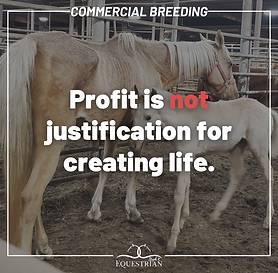
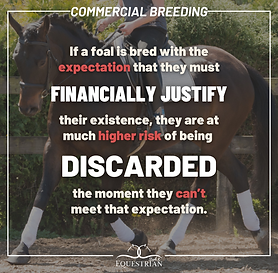
Profit is not justification for creating life. No horse is rideable or profitable forever. If a foal is bred with the expectation that they must financially justify their existence, they are at much higher risk of being discarded the moment they stop meeting that expectation.
Not to mention, there are infinitely many ways to make money that are easier, more reliable, and have fewer ethical complications than breeding horses. There's no ethical reason to be creating new horses with the intention of turning a profit and passing them along.
Keep reading to learn more about the next key to ethical, sustainable breeding: the PRIME standard.
The PRIME Breeding Standard


If we’re going to breed horses, we need to hold ourselves to the highest possible standards. Steph developed the "PRIME" standard to help others understand the essential criteria every mare and stallion should meet before even considering breeding:
P – PROVEN: Potential is not enough. Breeding-quality horses must have a solid record demonstrating their exceptional temperament, soundness, trainability, and suitability for their intended purpose.
R – REGISTERED: History, ancestry, and genetics must be documented. Registration isn’t just a piece of paper—it’s a tool for responsible breeding decisions, helping us evaluate patterns of inheritance and ensure that undesirable traits aren’t being passed down.
I – IDEAL CONFORMATION: Ideal conformation supports soundness, longevity, and suitability for the expected career or lifestyle. Heritability is complex, we can't assume two good horses will create a great one. Consider: if the foal inherited the least desirable aspects of both parents, would they still be exceptional? If not, the breeding shouldn’t happen.
M – MINDSET: Also regarded as temperament, this is essential and highly heritable. A responsibly bred horse should have:
-
Low reactivity and high resilience – They take new experiences in stride, making them safer to handle and more confident in life.
-
Willingness to engage with people – Since they’ll spend their lives in human environments, they should have a natural interest in working with people and be cooperative by nature, not just made cooperative through extensive training.
-
Intelligence and drive – A good balance of trainability and thoughtfulness, neither over-reactive or dull.
Just like with conformation, we have to consider worst-case scenarios: if the foal inherits the most difficult aspects of both parents’ temperaments, will they still be a safe animal to work with?
E – ENTIRE LIFETIME COMMITMENT: If we create a life, we are responsible for that life. We've already explored this concept in-depth in the information above, and you can use this link to read about what it means to make a Lifelong Commitment to a horse.
We hope all of this information helps other equestrians to make informed, ethical, and sustainable decisions regarding their horses.
Interested in personal breeding, but not sure how to navigate the ethics? Steph can offer guidance and support: steph@skequine.com
Looking to ensure your established breeding operation is ethical & sustainable? Steph is happy to help: steph@skequine.com